Contents
How ChatGPT chooses its sources.
When a question needs recent or specific information, ChatGPT searches the web. It turns the question into targeted queries, reads the pages it finds, then writes an answer that cites its sources.
ChatGPT decides whether it needs the web to answer well.
It looks through pages crawled by its own bot and results from third-party search providers.
It writes a short answer and cites a few pages, with a link.
To be cited, a page first has to be readable and findable.
- OAI-SearchBot allowed in robots.txt
- Page properly indexed on Google and Bing
- Text readable without JavaScript
Among the pages it finds, it uses the ones that answer most clearly.
- The answer in the first few lines
- One idea per section, a real FAQ
- Precise, up-to-date facts
Google vs. ChatGPT: what changes, what stays.
Google ranks pages for a query. ChatGPT breaks one question into several searches, reads lots of pages and cites only a few. SEO fundamentals still apply, but the way you get picked changes. That's what GEO for ChatGPT, or generative engine optimization, is about.
For 9 out of 10 questions, ChatGPT runs at least two different searches.
Only 15% of the pages ChatGPT reads end up cited in its answer.
A page ranking #1 on Google gets cited 3.5 times more often than a page outside the top 20.
- A page that ranks well on Google has a head start.
- Clear structure and reliable content are still the foundation.
- Your site has to be readable by crawlers.
- Cover the whole topic, not a single keyword: most of ChatGPT's searches show no volume in SEO tools.
- The answer has to be easy to pull out, section by section.
- No fixed ranking: answers change from one run to the next.
Figures: AirOps study of 15,000 questions asked to ChatGPT, March 2026.
OpenAI's crawlers: which one to allow?
OpenAI runs several crawlers, each with a specific job. For ChatGPT search SEO, only one really matters.
Crawls the web for ChatGPT search. Sites that block it don't appear in ChatGPT's answers, except as plain navigational links.
Collects content that may be used to train OpenAI's models. Blocking it has no effect on your citations.
Opens a page when a user asks, for example to answer their question. It doesn't crawl the web on its own and doesn't decide what shows up in search.
About 24 hours after you update robots.txt, ChatGPT search takes the change into account.
If you allow both OAI-SearchBot and GPTBot, a single crawl can serve both.
What makes a page easy to cite.
OpenAI doesn't publish ChatGPT ranking factors. These six practices make a page easy to read and reuse, for ChatGPT and for Google. Hover or tap them to see them on the page.
Writing rules, applied to every article.
The Generator starts from real search data.
- Direct answer
- Structured headings
- Real FAQ
- Matches search intent
What others say about you.
ChatGPT doesn't just read your site. It also draws on what the web says about your brand: discussions, reviews, comparisons, videos. What others write about you matters as much as what you write.
Ahrefs study of 75,000 brands, December 2025. A correlation, not a guarantee.
Share of citations, US queries, Ahrefs, September 2026. Discussions and reference sites carry a lot of weight.
Good news for smaller brands: for ChatGPT, classic authority signals (branded searches, site authority) weigh less than they do for Google.
Comparisons, forums, niche communities: bring a real answer, not an ad.
On the platforms your customers actually check before they choose.
Demos, tutorials, talks: video is the signal most closely tied to AI visibility.
Name, offer, prices, contact details: identical on your site, your profiles and directories.
- Ask it to describe your company and what you offer.
- Compare with reality: name, services, prices, service area.
- Something's wrong? Find the page it comes from and get it corrected, or update your own pages and profiles.
- Run the test again next month.
How to optimize your website for ChatGPT.
Six settings to optimize for ChatGPT search, from most important to optional. Check them off as you go.
Open your site to OAI-SearchBot
OAI-SearchBot needs to read the pages you want cited. You can block GPTBot without losing your citations.
yoursite.com/robots.txt# ChatGPT search: allow
User-agent: OAI-SearchBot
Allow: /

# Model training: your call
User-agent: GPTBot
Disallow: /

Sitemap: https://yoursite.com/sitemap.xml
Get properly indexed on Google and Bing
ChatGPT also relies on third-party search providers. A page that the major search engines index well is more likely to be found. For Bing, add your site to Bing Webmaster Tools and submit new pages with IndexNow.
Guide: Bing Webmaster Tools and IndexNow →Keep your sitemap up to date
A sitemap listed in robots.txt, with each page's last-modified date, helps crawlers find your new articles.
yoursite.com/sitemap.xml<url>
  <loc>https://yoursite.com/blog/my-article</loc>
  <lastmod>2026-10-26</lastmod>
</url>
Serve text that's readable without JavaScript
The title, the answer and the sections need to be in the HTML your server sends. Otherwise, a crawler may see an empty page.
<!-- What a crawler sees if everything depends on JavaScript -->
<div id="app"></div>

<!-- Readable page: the text is already there -->
<h1>Article title</h1>
<p>The direct answer, right in the intro.</p>
Describe your pages with structured data
Schema.org markup (Article, FAQPage, Organization) clearly labels the page's title, author, date and questions. Google uses it. OpenAI doesn't say whether it does, but it costs you nothing.
Put the answer before the details
The setting that makes the biggest difference isn't technical: open every page and every section with a clear answer.
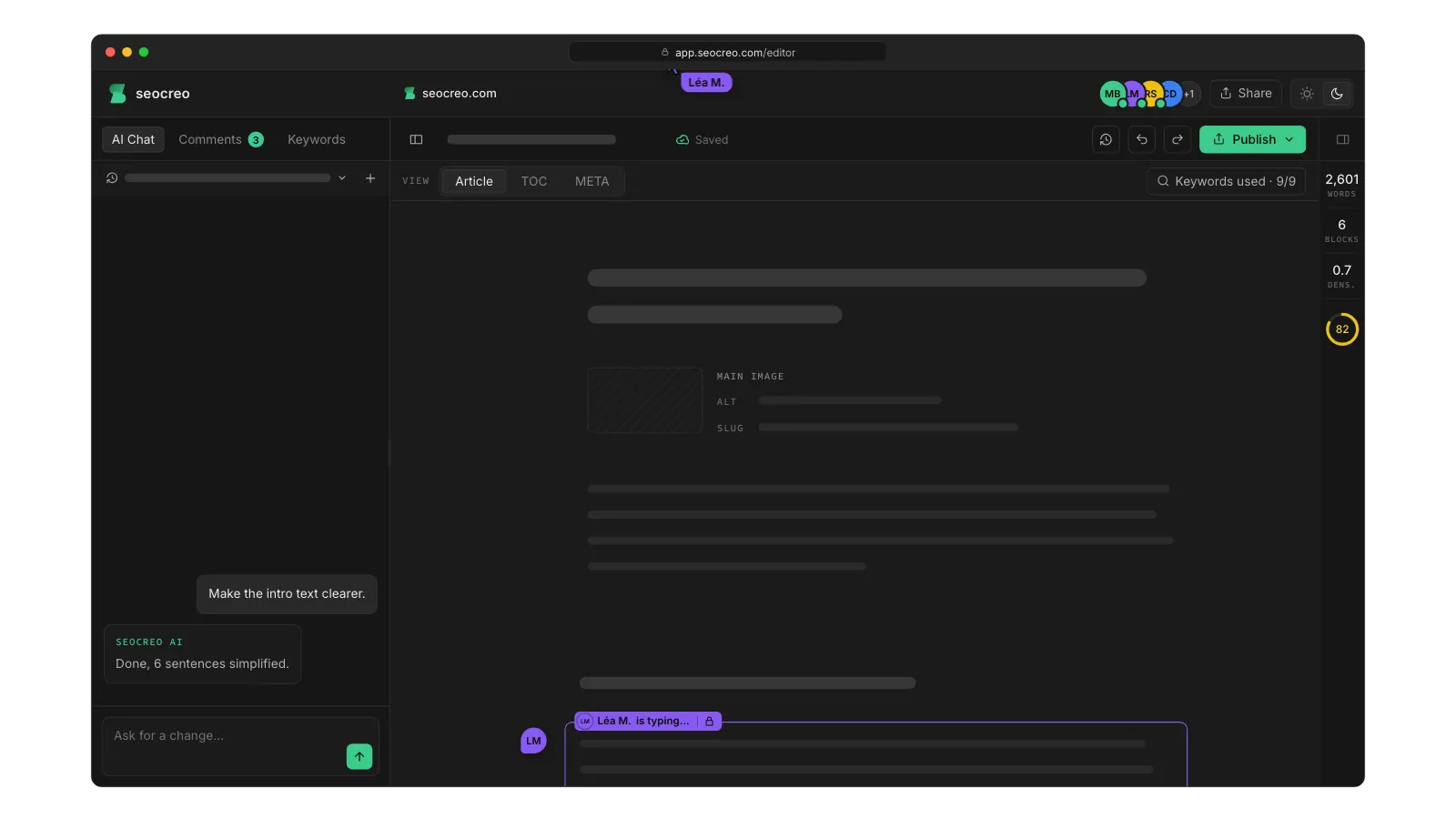
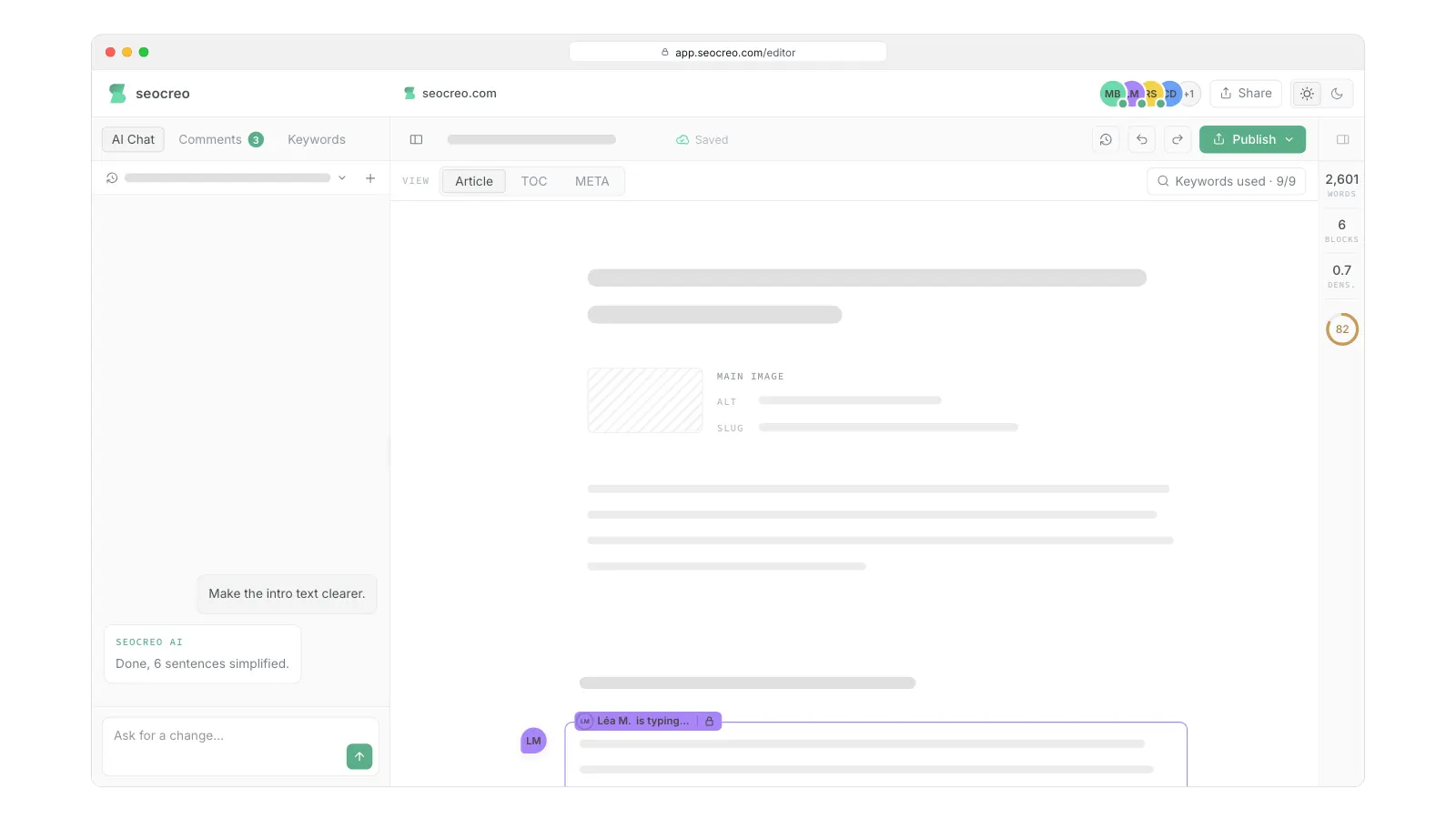
Your article is ready. Polish it together.
Your team and your clients work on the same article at the same time. The AI assistant does what you ask, and the article goes to your site in one click.
Measure your visibility in ChatGPT.
OpenAI doesn't offer a console for site owners, the way Search Console does for Google. So you measure ChatGPT traffic and visibility by cross-checking four indicators, from the most reliable to the most indirect.
Your ChatGPT referral traffic
Since May 13, 2026, Google Analytics automatically groups visits from AI assistants into a separate channel, “AI Assistant”. ChatGPT is one of them.
- Open the reportReports › Acquisition › Traffic acquisition.
- Find the “AI Assistant” channelIt groups ChatGPT, Gemini, Claude and other assistants. Google's AI Overviews and AI Mode aren't in it: they count as Organic Search.
- Isolate ChatGPTAdd the “Session source” dimension and keep
chatgpt.com. - Look at what mattersLanding pages first, then conversions from those visits.
utm_source=chatgpt.comChatGPT adds this parameter to its links, but usually doesn't pass the referring page. From October 8 to 15, 2026, a bug dropped it: on those days, ChatGPT visits were counted as direct traffic.
People who read ChatGPT's answer without clicking. The number is a floor, not a total.
How ChatGPT reads your pages
Your server logs record every visit from OpenAI's crawlers. Two of them tell you different things.
Your page is being crawled for ChatGPT's search index. No visits means the page is unlikely to be cited.
Your page was opened at a user's request, for example to answer their question. ChatGPT reads more pages than it cites: it's a good sign, not proof of a citation.
- Visits per day and per page.
- Errors: a blocked or broken page never gets cited.
- Important pages the crawlers never read.
- The IP address: check it against the lists OpenAI publishes (
openai.com/searchbot.json,openai.com/chatgpt-user.json). A fake bot can borrow their name.
Is your site behind a service like Cloudflare? Its AI crawler dashboard shows these visits without digging into your logs.
Your citations: the question test
It's the only way to see directly whether ChatGPT cites you. Answers vary a lot from one run to the next, so a consistent method matters more than a one-off check.
- 1List 20 to 50 questions
The ones your customers ask, each tied to a page you track.
- 2Ask each one 3 to 5 times
A single answer tells you nothing: it changes from run to run.
- 3Keep the same conditions
Temporary chat, no history, always from the same country.
- 4Write down what you see
Cited with a link, named without a link, or missing. Plus the competitors that get cited.
- 5Compare every month
Use the first month as your baseline. A new model can shake everything up.
Run the same calculation across every brand cited and you get your share of voice: your citations divided by all citations.
Indirect effects
Many people see your name in ChatGPT, then search for you on Google or type in your URL. Those visits don't carry the ChatGPT tag. Three estimates bring them to light.
In Search Console, track the queries that include your brand name. An effect from ChatGPT shows up a few weeks later.
Compare it with a baseline period, after ruling out your campaigns and seasonality.
Add a “ChatGPT / AI” option to your forms. It gives the clearest answer, from a small share of customers.
Your monthly dashboard
| Indicator | Where | How often | What it shows |
|---|---|---|---|
| Visits | Google Analytics, AI Assistant channel | Monthly | Clicks from ChatGPT, at the very least |
| Crawling | Server logs | Monthly | Whether ChatGPT reads your pages without errors |
| Citations | Your question tests | Monthly | Your citation rate and share of voice |
| Indirect effects | Search Console, Analytics, forms | Quarterly | A trend, to read with caution |
What about the AI reports in Search Console and Bing?
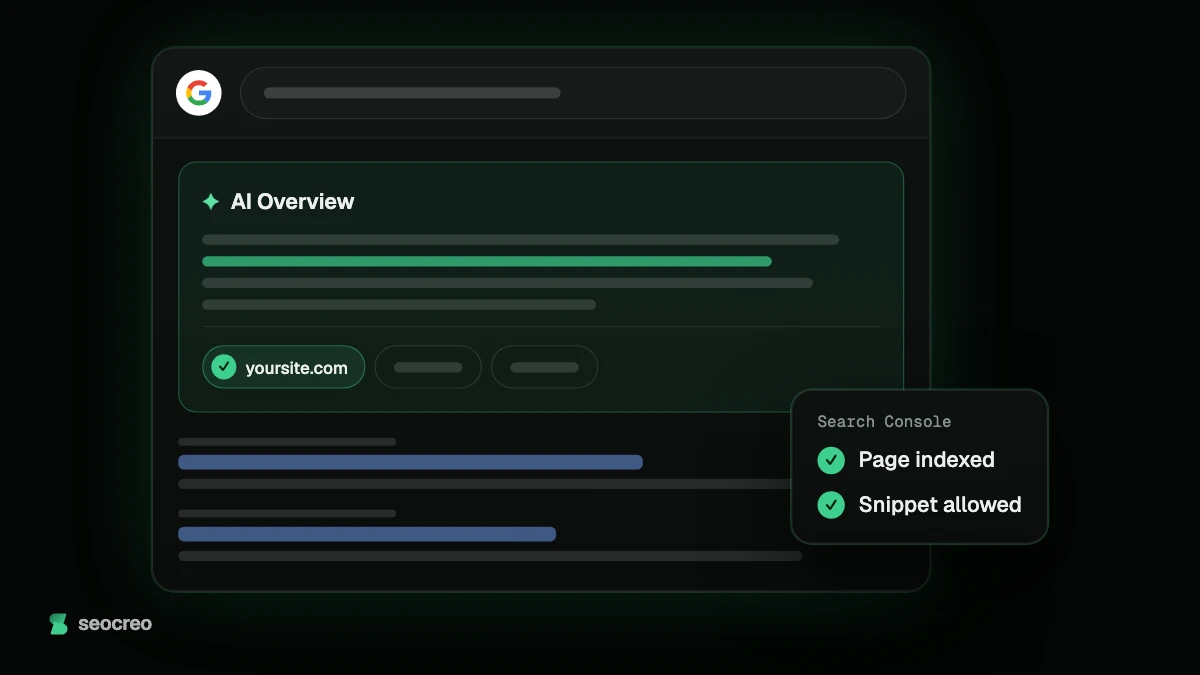
Counts the impressions of your pages in generative AI features on Google Search. No clicks, impressions only.
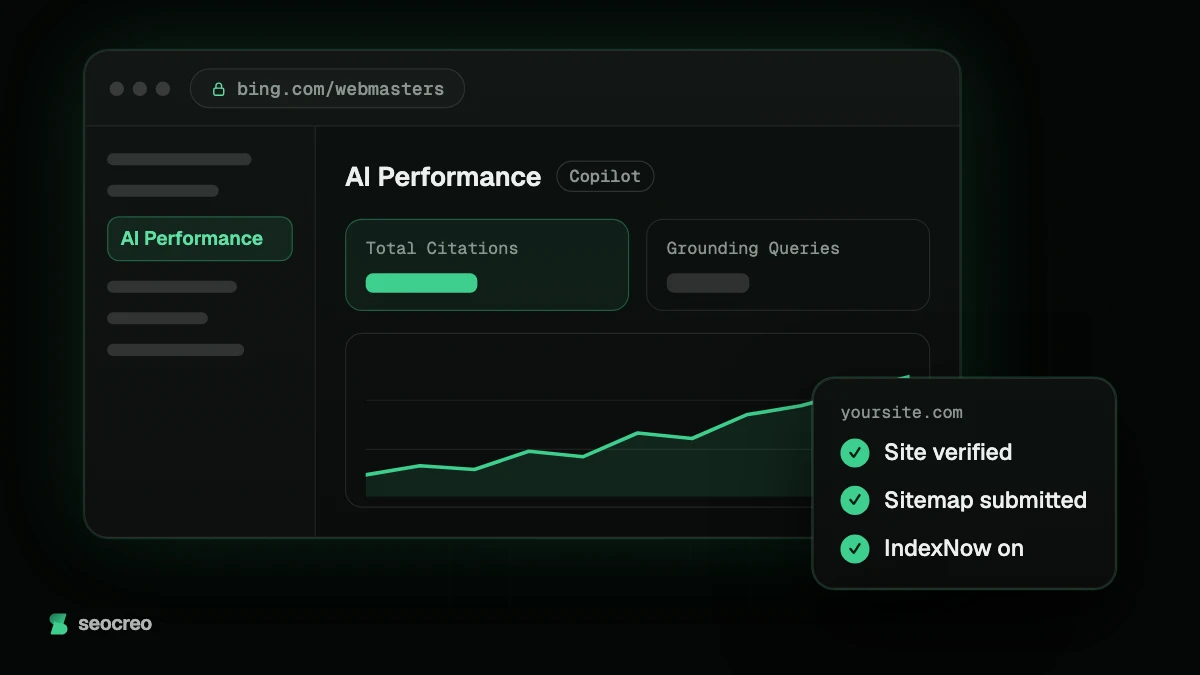
Counts how often your pages are cited in Copilot answers, Bing's AI summaries and select partners, with the cited pages and the queries the AI used.
Common myths.
Six claims you hear a lot about how to rank in ChatGPT, and what's actually true.
No. OpenAI says any public website can appear in ChatGPT search, as long as it lets OAI-SearchBot in.
No. The same page works for Google, ChatGPT and other AI tools. What differs from one AI to the next is how it finds your pages: its crawler, its sources, its settings. That's what each guide in this series covers.
No. OpenAI doesn't mention it in its crawler documentation. A well-configured robots.txt, an up-to-date sitemap and readable pages matter far more.
No. GPTBot is for model training. To get cited, OAI-SearchBot is the one that counts.
No, but it helps a lot. In the AirOps study, pages ranking #1 were cited 43% of the time: more often than others, but not every time.
No. Answers change from one run to the next, and with every new model. That's why monthly tracking matters.
Frequently asked questions.
Do you need to rank on Google to get cited by ChatGPT?
It's not required, but it helps a lot. In an AirOps study from March 2026, more than half of the pages ChatGPT cited ranked in Google's top 20 for at least one of the searches it ran.
Can a small business get cited by ChatGPT?
Yes. For ChatGPT, classic brand authority weighs less than it does for Google. A clear page on a specific topic, plus mentions where people talk about your field, can be enough to get recommended by ChatGPT.
ChatGPT says wrong things about my business. What can I do?
Find the page that contains the error and get it corrected, then update your own pages and profiles so the details match everywhere. Run the test again the following month.
How long does it take to show up in ChatGPT?
A robots.txt change is picked up in about 24 hours. The rest depends on how your pages are crawled and on their quality. Nobody can guarantee a citation: no AI publishes its criteria.
How can I tell if ChatGPT visits my site?
Check your server logs. OAI-SearchBot visits come from ChatGPT search. ChatGPT-User visits mean a page was opened at a user's request, for example to answer their question. OpenAI publishes its crawlers' IP addresses so you can verify it's really them.
Does Search Console show my ChatGPT citations?
No. Search Console's generative AI performance report covers Google's AI Overviews, AI Mode and Discover. For ChatGPT, track the AI Assistant channel in Google Analytics and test your questions every month.
How do I keep a page out of ChatGPT?
Add a noindex meta tag to the page, and let OAI-SearchBot access it so it can read the tag. A page that's only blocked in robots.txt can still show up as a plain link.
Can Seocreo help me show up in ChatGPT?
Yes, that's the goal of every article: a direct answer at the top of each section, a FAQ based on the questions people actually ask, and a clear structure. These practices give you the best possible chance.
What topic do you want to be visible for?
Seocreo writes structured articles built to be picked up by ChatGPT and other AI tools, without sacrificing your Google rankings.
Get started for freeNo credit card
Built for Google and for AI
- Overview of OpenAI CrawlersOpenAI · accessed October 27, 2026
- Searching the web with ChatGPTOpenAI · Help Center · accessed October 27, 2026
- Publishers and Developers, FAQOpenAI · Help Center · accessed October 27, 2026
- What's new in Google Analytics (AI Assistant channel)Google · May 13, 2026
- Search Generative AI performance reports in Search ConsoleGoogle Search Central · June 3, 2026, updated August 31, 2026
- AI Performance in Bing Webmaster ToolsMicrosoft Bing · February 10, 2026
- ChatGPT UTM tag loss was a bugRelevant Audience · October 2026
- Influence of retrieval, fan-out and Google SERPs in ChatGPTAirOps · March 12, 2026
- Top Brand Visibility Factors in ChatGPT, AI Mode and AI OverviewsAhrefs · December 12, 2025
- The 50 Most-Cited Websites in ChatGPTAhrefs · September 2026
 GuideAI Overviews
 GuideBing Webmaster Tools